

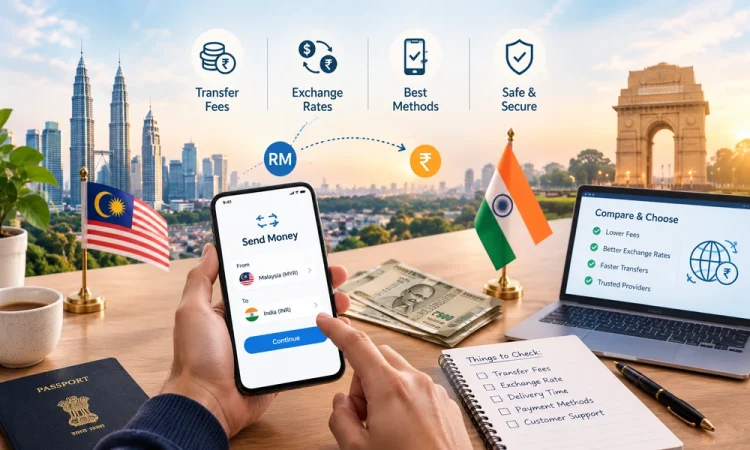
- The total cost of a transfer has two parts: the transfer fee and the exchange rate margin, and the margin can sometimes be the larger of the two.
- Inward remittances to India attract no TCS. The ₹10 lakh threshold applies to money leaving India, not arriving.
- Money sent to a parent’s or spouse’s account is exempt under Section 56(2)(x), with no upper limit.
- Compare what the recipient actually gets, never the advertised rate or the headline fee.
Understanding the Cost of Sending Money from Malaysia to India
Every international transfer carries two costs: a visible transfer fee and a less apparent exchange rate margin.
When you send money to India the transfer fee differs across providers and is typically charged as a flat amount per transaction. The exchange rate margin is the difference between the mid-market rate and the rate the provider offers. For example, if the mid-market rate is approximately RM1 = ₹23.2 and a provider quotes ₹22.30, the margin works out to about 4%, which is deducted before any transfer fee is applied.
Why the Exchange Rate Matters More Than the Fee
The example below shows why the exchange rate matters more than the fee
The conclusion is this: a provider with a transparent, low fee and a near-mid-market rate will beat a zero-fee provider hiding its margin in the quote. The only number that settles it is the final rupee figure the recipient’s account receives.
How to Compare Providers Before You Send
Instead of the banner rate, get a live quote for the exact amount you’re sending
- Then check three things:
- The recipient’s final amount,
- The payout method (bank account, UPI, cash pickup),
- And the delivery time.
- Quote two or three providers for the same amount on the same day. Rates move during the day, so comparing two days tells you nothing.
- When using the bank money transfer services, assess the remittance fees for sending money.
An indicative mid-market MYR/INR rate sits near ₹23.2. Anything quoting ₹22.3 to ₹22.8 is charging you between 2% and 4% invisibly.
How do different types of Malaysia-to-India transfers take place?
- Online remittance services: The sender pays ringgit to a licensed remittance provider through its app or website. The provider converts the amount and credits the rupees to the recipient’s Indian bank account or UPI ID.
- Bank wire transfers: The sender’s Malaysian bank sends the funds by telegraphic transfer through the banking network, sometimes via intermediary banks, to the recipient’s bank in India.
- Cash pickup: The sender pays the provider and receives a reference number. The recipient takes this number and valid photo ID to an agent location in India to collect the cash.
Documents You Need Before You Send
KYC verification is required for the first transfer through any provider.
- MyKad or passport,
- proof of address, and
- sometimes a payslip or employment letter to establish the source of funds.
For the recipient, you need
- the account number and
- IFSC code for a bank payout, or
- the UPI ID.
An incorrect IFSC can bounce a transfer back days later, and the return leg may come back at a worse rate than the one you sent at.
How Much Money Can You Send from Malaysia to India?
. Banks here generally allow up to RM200,000 a day for outward telegraphic transfers.
Money arriving in India is not touched by it. There is no general ceiling on what an NRI can remit into India through banking channels.
Is Money Sent from Malaysia to India Taxable?
Keep the remittance record anyway: a clean paper trail prevents a genuine family transfer from becoming a query three years later.
On the Malaysian side, Malaysia taxes income you earned there.
Common Mistakes That Cost You Money
- Comparing fees instead of payouts. The cheapest advertised fee frequently delivers the least.
- Sending on a day you didn’t check the rate.
- One large transfer instead of scheduled ones. If you send monthly, a rate alert beats speculating.
- Getting the recipient’s IFSC wrong. It comes back, but not at your original rate.
- Assuming the bank is the safe option and the app is the risky one. Both are regulated. Only one is cheap.