


The Core Pillars of Modern Search Performance
To truly improve your website’s SEO, it’s essential to grasp the fundamental mechanisms by which search engines operate. Google, for instance, operates as a highly automated system that continuously explores the web to discover, categorize, and rank content.
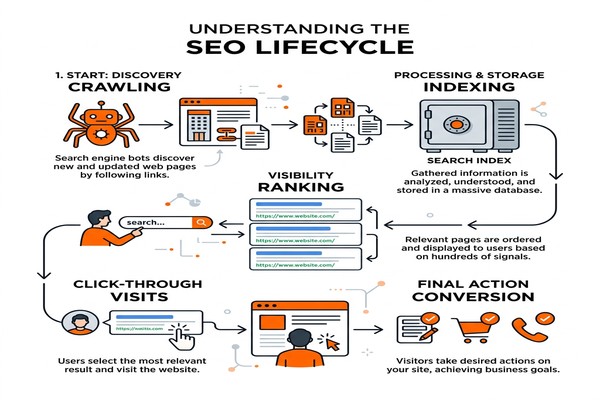
The journey of your website content through a search engine typically involves three key stages:
- Crawling: Search engines use programs called “crawlers” or “spiders” to visit web pages, read their content, and follow links to other pages. This is how they discover new and updated information. The vast majority of sites in Google’s results are found and added automatically as it crawls the web.
- Indexing: Once crawled, the information gathered from your pages is processed and stored in a massive database, known as the search index. This index is like a digital library that Google consults when a user searches. For Google to accurately understand your page, it needs to access the same resources (like CSS and JavaScript) that a user’s browser would.
- Ranking: When a user types a query, the search engine sifts through its index to find the most relevant pages. These pages are then ordered based on hundreds of ranking signals, aiming to provide the best possible answer to the user’s query.
A critical concept guiding Google’s ranking philosophy, especially for content, is E-E-A-T: Experience, Expertise, Authoritativeness, and Trustworthiness. In 2022, Google explicitly added “Experience” to the acronym, emphasizing that content should demonstrate actual use or knowledge. This means your content should not just be factually correct, but also show that it was produced with genuine insight, perhaps from using a product, visiting a place, or living an experience.
Google’s “Search Essentials” outlines the most important elements for a website to be eligible to appear in Google Search. Adhering to these guidelines is a foundational step. Beyond these, tools like Google Search Console and other analytics platforms become invaluable for monitoring your website’s performance and identifying areas for improvement. Setting up a Search Console account, for instance, helps you monitor and optimize how your website performs on Google Search, providing crucial data on impressions, clicks, and indexing status.
However, it’s equally important to distinguish between effective, modern SEO practices and outdated tactics that can actually harm your rankings. For example, keyword stuffing – the excessive repetition of the same words – is tiring for users and violates Google’s spam policies. Similarly, while meta descriptions are important for click-through rates, Google Search doesn’t use the keywords meta tag for ranking. The length of content alone doesn’t matter for ranking purposes, meaning there’s no magical word count target. Instead, focus on providing comprehensive, high-quality information that truly helps your audience.
Here are the fundamental SEO principles every website owner should understand:
- User-First Approach: Always create content and design your site with the user in mind.
- Crawlability & Indexability: Ensure search engines can easily find, read, and understand your content.
- Relevance: Provide content that directly answers user queries and matches search intent.
- Authority: Build credibility and trust through high-quality content and external validation (backlinks).
- Technical Health: Maintain a fast, secure, and mobile-friendly website.
- Continuous Optimization: SEO is an ongoing process that requires regular monitoring and adaptation.
Strategies for SEO-friendly website optimization
Improving your website’s SEO is a multifaceted endeavor that touches upon nearly every aspect of your online presence. It’s about ensuring your content is relevant, visible, and structured in a way that both search engines and users appreciate. This involves a strategic blend of content creation, technical adjustments, and continuous analysis. When considering how to enhance your online visibility, think about comprehensive SEO-friendly website optimization that covers all bases.
At its core, effective SEO aims to achieve “information gain” – offering new perspectives, data, or insights not found on other pages targeting the same search query. This differentiation is key to standing out. We also focus on understanding “search intent” – what users truly want when they type a query – to create content that directly addresses their needs. This often leads to the development of “topic clusters” around “pillar pages,” which are comprehensive guides to broad subjects, supported by several interconnected, more specific articles. Strong “internal linking” within these clusters helps distribute authority and guides users and crawlers through your site.
The structure of your URLs should be clear and descriptive, and the use of “canonical tags” helps manage duplicate content issues. Furthermore, ensuring your entire site uses “HTTPS” is no longer optional; it’s now a security standard and a minor ranking factor.
Keyword Research for SEO-friendly website optimization
Effective keyword research is the bedrock of any successful SEO strategy. It’s about understanding the language your target audience uses to find information, products, or services online. This involves more than just identifying popular terms; it requires a deep dive into user intent and the competitive landscape.
We often categorize keywords based on their position in the customer journey:
- Top-of-Funnel (ToFu) Keywords: These are broad, informational queries typically used by users in the awareness stage. Examples include “what is SEO” or “how to improve website traffic.” While they attract a large audience, they may not lead to immediate conversions. However, they are crucial for building topical authority and brand awareness.
- Bottom-of-Funnel (BoFu) Keywords: These are specific, transactional queries used by users closer to making a purchase decision. Examples include “best SEO tools for small business” or “hire SEO consultant NYC.” These keywords have higher conversion potential but often lower search volume and higher competition.
The shift in search behavior, partly influenced by AI tools and AI Overviews, has led to a decrease in clicks for purely informational ToFu queries. This means strategizing for BoFu keywords has become even more critical for driving direct business results.
When conducting keyword research, we analyze several factors:
- Search Volume: How many people are searching for this term?
- Competition Analysis: How difficult is it to rank for this keyword, given the current competitors? Tools like Semrush can provide a “keyword difficulty” score.
- Long-tail Keywords: These are longer, more specific phrases (e.g., “affordable SEO services for e-commerce in Queens”). They often have lower search volume but higher conversion rates and less competition.
- Trending Topics: Tools like Exploding Topics can help identify emerging keywords, allowing you to get ahead of the curve.
Understanding the user journey – from initial awareness to consideration, and finally to purchase – allows us to map keywords to specific content that addresses their needs at each stage. This holistic approach, combined with an understanding of semantic search (where search engines understand the context and meaning behind queries, not just exact keywords), ensures our content is relevant and discoverable.
On-Page Tactics for SEO-friendly website optimization
Once you have your target keywords, the next step is to implement them effectively on your web pages. On-page SEO involves optimizing individual page elements to improve content relevance and visibility.
- Title Tags: The title tag is one of the most critical on-page elements. It’s the headline displayed in search results and browser tabs. We ensure title tags are unique, concise (under 60 characters to avoid truncation), and include the primary keyword near the beginning, accurately describing the page’s content.
- Meta Descriptions: While not a direct ranking factor, a compelling meta description (around 105-155 characters) acts as an advertisement in the SERPs. It should include your target keyword, a clear call to action, and highlight a specific benefit to encourage higher Click-Through Rates (CTR). Google may pull snippets from your page content if your meta description isn’t optimal, but a well-crafted one gives you more snippet control.
- Header Hierarchy: Using heading tags (H1, H2, H3, etc.) logically structures your content, making it easier for both users and search engines to understand. Each page should have one H1 tag for the main topic, with H2 Tags for major sections and H3 Tags for sub-sections. This improves readability and helps establish the relevance of the content.
- Keyword Placement: Integrate your primary and secondary keywords naturally throughout your content, especially in the first 100 words, body paragraphs, and concluding remarks. The key is to use natural language and incorporate synonyms to avoid keyword stuffing, which Google penalizes.
- Image Alt Text: Images are crucial for user engagement, but search engines can’t “see” them. Alt text (alternative text) describes the image content for visually impaired users and search engines, improving accessibility and image search discoverability. We use descriptive alt text that includes relevant keywords where appropriate.
- Video Optimization: If your website includes videos, optimizing them is essential. This involves using descriptive titles and descriptions, creating transcripts, and embedding them near relevant text. If your website includes pages primarily about individual videos, people may also discover your site through video results in Google Search.
By meticulously optimizing these on-page elements, we signal to search engines the topic and value of our content, enhancing its chances of ranking higher and attracting more qualified traffic.
Technical Excellence and User Experience
The foundation of a high-performing website, and consequently, strong SEO, lies in its technical health and the experience it provides to users. Technical SEO focuses on the backend elements that ensure search engines can efficiently crawl, index, and understand your site, while a superior User Experience (UX) keeps visitors engaged and signals quality to search algorithms.
Website speed and mobile responsiveness are no longer just good-to-haves; they are critical ranking factors. Google has explicitly stated that site speed directly impacts rankings, and with the shift to mobile-first indexing (and now, essentially, mobile-only indexing for new sites), a website’s mobile performance is paramount. Tools like Google’s PageSpeed Insights and Lighthouse testing tool provide invaluable data on your site’s performance and offer actionable recommendations. These tools also measure Core Web Vitals (Largest Contentful Paint, Interaction to Next Paint, and Cumulative Layout Shift), which are crucial metrics for assessing user experience.
Beyond speed, other technical elements contribute significantly:
- Robots.txt: This file guides search engine crawlers, telling them which parts of your site they should or shouldn’t access.
- XML Sitemaps: These files list all the important pages on your site, helping search engines discover and index your content more efficiently.
- Structured Data (Schema.org): Implementing Schema.org markup provides search engines with explicit information about your content (e.g., product reviews, recipes, events), making your pages eligible for rich snippets and other special features in search results.
- Broken Link Building: Identifying and fixing 404 errors (broken pages) is crucial for user experience and crawl budget. A proactive strategy involves finding sites that link to broken pages elsewhere and suggesting your relevant, working content as a better alternative.
- 301 Redirects: When you move or delete a page, implementing a permanent 301 redirect ensures that search engines and users are seamlessly directed to the new location, preserving any SEO value the old page had.
Optimizing Website Speed and Mobile Responsiveness
A slow website is a major deterrent for users and a red flag for search engines. Statistics show that slow loading times significantly increase bounce rates. Google prioritizes faster websites in search results because they offer a better user experience.
Here are key steps to optimize website speed:
- Image Compression and Optimization: Large, unoptimized images are a primary culprit for slow loading times. We compress images without sacrificing quality, use modern formats like WebP, and implement lazy loading to load images only as they become visible on the screen.
- Minification: This involves removing unnecessary characters (like white space and comments) from your HTML, CSS, and JavaScript files to reduce their size.
- Browser Caching: By enabling browser caching, you instruct users’ browsers to store parts of your website (like images and stylesheets) locally, so subsequent visits load much faster.
- Minimize HTTP Requests: Each element on your page (images, scripts, stylesheets) requires an HTTP request. Reducing the number of these requests can significantly speed up your site. This often involves combining files or eliminating unnecessary third-party scripts.
- Efficient Hosting: Sometimes, your web host is the bottleneck. Upgrading to a more robust hosting plan or using a Content Delivery Network (CDN) can dramatically improve load times.
For mobile responsiveness, the focus is on providing a seamless experience on any device. The majority of searches are done on mobile, and Google’s mobile-first indexing means your mobile site is the primary version considered for ranking.
- Responsive Design: Your website should be built with a responsive design, meaning it automatically adjusts its layout and content to fit any screen size, from desktops to smartphones.
- Mobile Usability: Ensure text is readable without zooming, buttons are easily tappable, and there are no intrusive interstitial pages (ads that block content) that hinder the user experience. Poor mobile usability leads to user frustration and high bounce rates.
- Test Regularly: Use Google’s Mobile-Friendly Test or the mobile view in PageSpeed Insights to regularly check your site’s performance and usability on mobile devices.
Leveraging User Experience (UX) Signals
While Google doesn’t explicitly confirm all UX signals as direct ranking factors, it’s widely accepted that a positive user experience indirectly (and often directly) benefits SEO. Metrics like dwell time (how long a user stays on your page) and bounce rate (the percentage of visitors who leave after viewing only one page) are strong indicators of content relevance and quality.
Optimizing for UX signals means making your content and site as helpful and engaging as possible:
- Scannability and Readability: Most users scan online content rather than read every word. Structure your content with clear headings, short paragraphs, bullet points, and bolded text to improve scannability. Use simple, straightforward language. A good tool like the Hemingway Editor can help simplify your writing to a 6th-8th grade reading level, making it accessible to a broader audience.
- Navigation Flow: A logical and intuitive website navigation helps users find what they’re looking for quickly. Avoid orphaned pages (pages with no internal links) and ensure important content is easily accessible within a few clicks from the homepage.
- Visual Demonstrations and Interactive Elements: Incorporate compelling visuals like custom graphics, charts, screenshots, and videos to explain complex concepts or showcase products. Visuals can significantly increase user engagement and provide information gain. Interactive elements, such as calculators or quizzes, can also boost dwell time.
- Accessibility Standards: Designing for accessibility ensures your website is usable by everyone, including people with disabilities. This aligns with Google’s people-first approach and can indirectly improve your SEO by broadening your audience.
By focusing on these UX elements, we create a website that not only pleases visitors but also sends positive signals to search engines about the quality and relevance of our content.
Content Strategy and Building Authority
In the realm of SEO, content is king, but authority is its crown. High-quality, original content forms the bedrock of your online presence, while building authoritative backlinks solidifies your website’s credibility and trustworthiness in the eyes of search engines.
Creating content that truly stands out is more crucial than ever. It needs to be original, helpful, and demonstrate genuine expertise. Regularly updating your content also signals freshness and relevance to search engines.
When it comes to building authority, authoritative backlinks are paramount. These are links from other reputable websites to yours, serving as “votes of confidence” that signal to search engines that your content is valuable and trustworthy. The more high-quality backlinks you acquire, the higher your domain authority is likely to be, which positively impacts your search rankings.
Strategies for acquiring these valuable links include creating “linkable assets” (unique studies, free tools, comprehensive guides), guest blogging on relevant industry sites, and leveraging digital PR to secure mentions and links from news outlets. Social signals (shares, likes, comments) and word of mouth also play a role, indirectly boosting visibility and potentially leading to natural backlinks.
Feature Updating Existing Content Creating New Content Effort Generally less effort (editing, adding) More effort (research, writing from scratch) Immediate Impact Can see faster ranking improvements for existing keywords Takes longer to rank, especially for competitive new keywords Keyword Strategy Optimize for existing keywords, target long-tail variations Target new, trending, or less competitive keywords Authority Building Reinforces existing authority, keeps content fresh Establishes authority on new topics, broadens reach User Experience Ensures accuracy, relevance, and better engagement over time Addresses new user needs, captures new audience segments Traffic Potential Improves rankings for current traffic, captures missed queries Attracts new traffic from untapped search queries GSC Data Use Highly effective for using GSC query data to identify gaps Less direct GSC data for initial creation, more for post-publish analysis The Role of High-Quality, Original Content
Google’s algorithms increasingly prioritize people-first content – that which is helpful, reliable, and genuinely serves the user. This means moving beyond generic, surface-level information and providing deep, insightful, and unique perspectives.
Key aspects of high-quality, original content include:
- Helpful Resources and Reliable Information: Your content should thoroughly answer user questions and provide accurate, verifiable information. This builds trust with your audience and with search engines.
- Content Audits: Regularly auditing your existing content is crucial. Identify outdated or underperforming pages. Update them with fresh information, new data, and improved formatting. Sometimes it’s better to update existing content than create new content, especially if the old content already has some authority.
- Avoiding “Content Debt”: This refers to the accumulation of old, irrelevant, or low-quality content that can drag down your overall site performance. Regular content pruning and updating prevent this.
- Information Gain: As mentioned earlier, this is about offering new perspectives, data, or insights that are not available elsewhere. This could be proprietary data from your business, unique case studies, or novel solutions to common problems.
- Visual Content and Scannable Formatting: Break up long blocks of text with images, videos, infographics, and clear headings. This improves readability and engagement.
- Expertise Demonstration: Show, don’t just tell. Document your processes, share experiences, and leverage proprietary data. This aligns with the “Experience” aspect of E-E-A-T.
- AI Impact on Content: With the rise of AI-generated content, differentiating your human-created content is more important than ever. AI can produce generic text, but it struggles to replicate genuine experience, unique insights, and original thought. Focus on what AI cannot easily do.
Building Authoritative Backlinks and Site Reputation
Backlinks are often described as “votes of confidence” from other websites. When a reputable site links to yours, it signals to search engines that your content is valuable and trustworthy, significantly boosting your domain authority.
Here’s how we approach building authoritative backlinks:
- Understanding Referral Traffic: Beyond SEO, backlinks drive referral traffic, bringing new visitors to your site from other sources.
- Broken Link Building: a highly effective strategy. We find websites that are linking to broken (404) pages on other sites. Then, we reach out to those webmasters and suggest our relevant, high-quality content as a replacement for their broken link. This is a win-win: they fix a bad user experience, and we gain a backlink. Tools like Semrush’s Backlink Analytics can help identify these opportunities.
- Creating Linkable Assets: Develop unique resources that other websites will naturally want to link to. This could be original research, comprehensive guides, free tools, or compelling infographics. For instance, a study on voice search or a free website traffic checker tool can attract thousands of backlinks.
- Guest Blogging and Digital PR: Write high-quality articles for other authoritative websites in your niche, including a link back to your site. Engage with journalists and influencers to earn mentions and links in their publications.
- Relationship Building: Network with other website owners, bloggers, and industry leaders. Genuine relationships can lead to natural linking opportunities.
- Natural Link Profiles and Anchor Text Diversity: Aim for a diverse range of backlinks from various reputable sources. The anchor text (the clickable text of the link) should also be natural and varied, avoiding over-optimization with exact-match keywords.
- Nofollow Annotations: For links from untrusted sources or user-generated content (like comments), use nofollow or ugc annotations to tell search engines not to pass authority through those links.
Building a strong backlink profile is a long-term strategy that requires consistent effort and a focus on creating truly valuable content that others want to cite.
Frequently Asked Questions about Website SEO
How does the role of AI and evolving search technologies impact SEO strategies?
The landscape of search is continually evolving, with AI and new technologies playing an increasingly significant role. We’re seeing the emergence of AI Overviews and generative search features directly within search results, which can answer user queries without them needing to click through to a website. This shift means that traditional SEO strategies need to adapt.
- Search Intent Shifts: AI can often directly fulfill informational queries, leading to fewer clicks for purely Top-of-Funnel content. This emphasizes the importance of optimizing for Bottom-of-Funnel keywords that indicate a stronger commercial or transactional intent.
- Content Differentiation: With AI capable of generating vast amounts of content, human-created content needs to offer unique value. Focus on demonstrating experience-based content, proprietary data, original insights, and genuine expertise (the “E” in E-E-A-T). This is what differentiates your content from generic AI output.
- Automated Crawling and Indexing: AI also assists search engines in more efficiently crawling and indexing content, as well as understanding its context and relevance. This means technical SEO remains crucial for ensuring your site is easily discoverable by these advanced systems.
- Future-Proofing Strategies: The key is to focus on creating content that AI cannot easily replicate – content that is deeply helpful, trustworthy, and demonstrates unique human experience. Optimizing for featured snippets, building strong brand authority, and diversifying your traffic sources beyond traditional organic search (e.g., social media, video platforms) have also become more important.
What is the importance of local SEO for businesses?
For businesses with a physical location or those serving a specific geographic area, local SEO is indispensable. It’s about optimizing your online presence to attract customers from your immediate vicinity.
- Google Business Profile: The cornerstone of local SEO. Optimizing your Google Business Profile with accurate information (name, address, phone number, hours), high-quality photos, and detailed service descriptions is crucial for appearing in local search results and the Map Pack.
- Proximity, Relevance, and Prominence: Google’s local ranking factors are heavily influenced by these three elements. Proximity to the searcher, relevance to the search query, and the prominence (authority and reputation) of your business all contribute.
- Local Keywords: Incorporate location-specific keywords (e.g., “SEO consultant Queens,” “web design New York City”) into your website content, meta tags, and Google Business Profile.
- Local Citations: Ensure your business information is consistent across online directories (e.g., Yelp, Yellow Pages).
- Reviews: Encourage happy customers to leave positive reviews on your Google Business Profile and other platforms. Reviews significantly impact local ranking and customer trust.
- Regional Intent: Understand that users searching for local services often have a strong regional intent and are closer to a purchase decision. Optimizing for local search captures this high-value traffic.
How long does it take to see the impact of SEO changes?
One of the most common questions in SEO is about the timeline for results, and the answer is: it varies. SEO is a long-term investment, not a quick fix.
- Crawl Frequency and Indexing Time: Every change you make to your website needs to be discovered and processed by search engine crawlers. This can take time. Some minor changes might be reflected in a few hours, while others could take several weeks or even months to fully impact your rankings. Google itself states that changes can take a few hours to several months to be reflected.
- Competition Levels: If you’re in a highly competitive industry, it will naturally take longer to see significant movement in rankings compared to a niche market.
- Domain Age and Authority: Newer websites typically take longer to build authority and rank compared to established domains with years of history and a strong backlink profile.
- Consistency: Consistent effort in content creation, technical optimization, and link building is key. Sporadic changes yield sporadic results.
- Patience and Long-Term Growth: We generally recommend waiting a few weeks to a few months to assess the impact of your SEO work. Expect impressions to increase over the next 4-6 months, with these impressions translating into clicks in the months that follow. SEO is about sustainable, long-term growth, not overnight success.
- Performance Monitoring: Continuous monitoring with tools like Google Search Console and Google Analytics is crucial for tracking progress, identifying what’s working, and making necessary adjustments to your strategy.
Conclusion
Improving your website’s SEO is a continuous journey, not a destination. It demands a commitment to understanding search engine algorithms, adapting to evolving technologies such as AI, and, most importantly, prioritizing the user experience above all else. By embracing the fundamental principles of crawling, indexing, and ranking, and by focusing on E-E-A-T, you lay a solid foundation for your online presence.
Through strategic keyword research, meticulous on-page optimization, and a commitment to technical excellence, you ensure your website is not only discoverable but also provides a seamless and engaging experience. Crafting high-quality, original content that offers genuine information gain and building authoritative backlinks are crucial for establishing your site’s credibility and trustworthiness.
The digital landscape will continue to evolve, but a user-first mindset, coupled with continuous optimization and strategic adaptation, will always be the key to unlocking sustainable growth and achieving a significant long-term ROI. By consistently applying these strategies, your website will not only rank higher but also become a valuable resource and a trusted authority in your niche.