
In modern manufacturing and refurbishment landscapes, laser cladding has emerged as a versatile and powerful technique for enhancing component life and performance. Unlike conventional coating or surfacing approaches, this method uses focused energy to deposit material precisely where it’s needed, whether to rebuild a worn part or to add protective layers. In today’s post, we’ll walk through how this technique works, why many industries are turning to it, and where it finds the greatest value in real‐world applications.
The Laser Cladding Process
At its core, the laser cladding process is a form of directed energy deposition (DED). In this approach, a high-power laser beam is directed at a substrate’s surface to create a small melt pool, while feedstock—often in the form of metal powder or wire—is simultaneously delivered into that molten zone. As the laser scans or moves relative to the part, the clad material fuses to the base, building up a coating or restoring worn geometry.
Here’s a simplified step-by-step overview:
- Surface preparation: The base substrate is cleaned, pretreated, and sometimes preheated to ensure suitable bonding.
- Laser irradiation: A finely controlled laser beam is focused onto a target spot on the substrate, melting a thin layer of the surface.
- Material delivery: Feedstock (powder or wire) is injected into the melt pool, where it melts and coalesces with the substrate.
- Motion & overlap: The laser and delivery head move over the surface (or the part moves beneath), depositing sequential tracks that overlap to form a continuous coating.
- Cooling and solidification: The heat dissipates rapidly, giving a metallurgically bonded layer with limited heat-affected zone (HAZ).
- Post-processing: Depending on tolerances, grinding, machining, or finishing may follow to achieve final dimensions and surface quality.
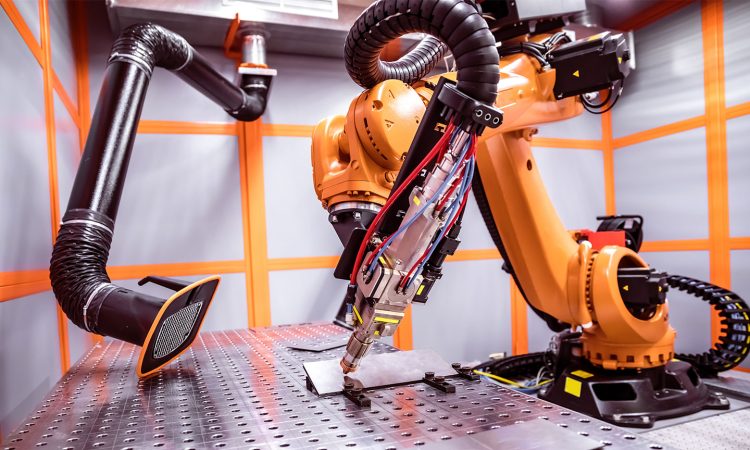
One variant often used in industrial settings is robotic laser cladding, where multiaxis robotic arms carry the laser head, ensuring repeatable trajectories, complex geometries, and consistent deposition in automated cycles. This robotic integration has made the method far more scalable and accurate.
Compared with some other coating or overlay methods, this technique yields a strong metallurgical bond, controlled heat input, and minimal dilution (i.e. minimal mixing of the base metal into the overlay).
Advantages and Strengths
Why are industries increasingly adopting laser cladding services? Here are some of the key benefits:
- Precision and control: Because the laser’s energy can be finely tuned, engineers can precisely control the clad thickness, heat penetration, and overlap, minimizing damage to adjacent areas.
- Strong metallurgical bonding: The clad layer typically fuses at the molecular level to the substrate, resulting in superior adhesion and structural integrity.
- Low heat-affected zone (HAZ): The heat input is concentrated and controlled, reducing distortion, residual stresses, and microstructural changes in the base material.
- Efficient material usage: Because feedstock is directed only where needed (and often with high deposition efficiency), waste is reduced relative to subtractive or blanket coating approaches.
- Versatility of overlay alloys: A wide spectrum of alloys—steel, stainless steel, nickel/cobalt superalloys, carbide composites—can be used to tailor surface attributes like wear and corrosion resistance.
- Component restoration: Worn or damaged parts can often be rebuilt to original dimensions, extending service life without full replacement.
- Automation and repeatability: In setups using robotic guidance, the process becomes highly repeatable, consistent, and scalable.
Of course, every technology has trade-offs. The capital cost of laser systems and robots can be high; optimizing process parameters demands expertise; and deposition speed is sometimes lower than bulk coating approaches. But for many critical or high-value parts, the long-term return justifies the investment.
Applications and Use Cases
Because of its adaptability and precision, laser cladding technology finds utility across many sectors. Here are a few prominent use cases:
- Aerospace: Turbine blades, seals, and vanes often require restoration or protective overlays that resist high-temperature wear.
- Power generation: Components such as boiler tubes, blades, rotors, and shaft surfaces benefit when corrosion or erosion protection is needed.
- Oil and gas / petrochemical: Drill bits, valves, pump parts, and pipeline sections often face abrasive, corrosive, and high-pressure environments.
- Automotive & heavy machinery: Engine parts, shafts, dies, molds, and wear surfaces can be upgraded or repaired with tailored overlays.
- Mining & construction equipment: Bucket edges, liners, excavation tools—all are subject to severe wear and are candidates for restoration.
- Tooling and molds: Dies, molds, and forming tools can be resurfaced or tweaked with customized coatings to enhance life or performance.
- Rail and transport: Wheels, rails, and track components sometimes get surface enhancements to resist wear and fatigue.
In many of these sectors, robotic laser cladding adds value because it enables complex paths, precise control, and integration into production lines. For instance, a robot arm might trace a turbine blade’s surface in multiple axes to deposit a high-performance alloy exactly where needed.
Conclusion
Laser cladding has matured into a compelling industrial coating and restoration method, offering precision, strong bonding, and capability to rebuild or protect components in challenging environments. When paired with robotic automation, it becomes even more powerful and scalable for modern production demands. As industries push toward greater reliability and cost efficiency, reliable laser cladding services play a vital role in maintaining competitiveness.
If you’re evaluating surface engineering options, laser cladding often competes strongly against other methods like spraying or plasma processes, particularly when you require metallurgical bonding and low thermal impact. And in situations where a full surface spray coating doesn’t suffice, it can complement thermal spray coating services as part of a hybrid approach to extend service life and performance.