
In the vast expanse of the Texas power grid – from the humming substations of Houston to the wind-whipped transmission lines in West Texas – there is one rule that stays the same: safety isn’t an option, it’s the mission. When you’re staring down thousands of volts, your gear is your shield. We’ve talked about the torque of an impact wrench and the grip of a good lug, but today we’re talking about the “silent” protector: Electrical Hazard (EH) Rated Footwear.
If you’ve ever wondered why your lineman boots have a specific stamp on the tongue or why you can’t just wear any old pair of leather kickers to the job site, you’re in the right place. We’re going to pull back the curtain on the science of EH ratings and why the right lineman boots with steel shank are essentially the only thing keeping you from completing a circuit you definitely don’t want to be a part of.
The Science of Staying Un-Grounded
At its core, electricity is lazy; it always wants to find the easiest path to the ground. In a high-voltage environment, your body can accidentally become that path. Electrical Hazard (EH) rated boots are specifically engineered to stop that from happening.
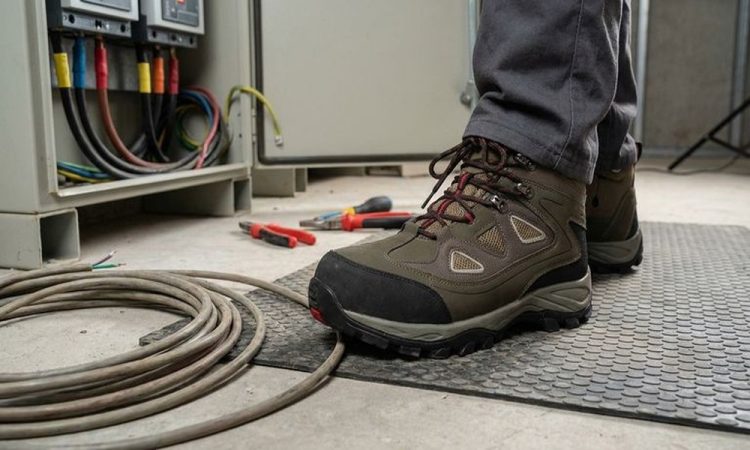
Unlike “Conductive” boots (which help bleed off static) or “Static Dissipative” boots (which prevent sparks), EH footwear is an insulator. It’s designed to be a secondary source of protection. If you accidentally step on a live wire or come into contact with an energized surface while wearing your lineman climbing boots, the non-conductive outsoles act like a dam, blocking the current from flowing through you into the earth.
Texas-Sized Fact: For a boot to earn that coveted EH rating under the ASTM F2413-18 standard, it has to be able to withstand 18,000 volts at 60Hz for one full minute in dry conditions with no more than 1.0 milliampere of leakage. That’s a lot of juice to hold back with just a piece of rubber!
Why Lineman Boots with Steel Shank are the Gold Standard
You might think that putting a piece of metal-a steel shank-inside a boot meant for electrical work sounds like a bad idea. Wouldn’t that conduct electricity?
Actually, it’s all about the “sandwich” construction. The steel shank is buried deep within the midsole, completely surrounded by non-conductive rubber and insulating materials. In climbing boots, that shank isn’t there for the looks; it’s there for structural integrity.
When you’re strapped into your Lineman Climbing Gear and standing on a narrow pole step for four hours, a boot without a shank would fold like a cheap lawn chair. The steel shank provides a rigid platform that supports your arch and distributes your weight. Without it, the “pressure points” from the climbing gaffs would not only destroy your feet but could eventually wear through the insulating layers of the boot itself.
Daily Carry: The Hand Tools that Put Your Boots to the Test
A lineman’s day is a masterclass in multitasking. You’re juggling hand tools like high-leverage lineman’s pliers, insulated screwdrivers, and skinning knives, all while maintaining a steady stance.
When you’re leaning out of a bucket or “hitching” up a pole to reach a stubborn bolt with your Lineman Impact Wrench, you’re putting massive torque on your ankles and soles. Modern lineman pole climbing boots are built with extra-tall shafts (often 10 to 16 inches) to provide the lateral support needed when you’re using heavy lineman equipment. If your boots slip or the sole fails while you’re mid-crimp with a 15-ton hydraulic tool, the physical “kickback” could be disastrous.
Is a “Safety Toe” Always Better?
This is the age-old debate in the breakroom: Steel Toe vs. Composite Toe.
- Steel Toes: Classic, incredibly strong, and durable. In an EH-rated boot, the steel cap is insulated so it doesn’t pose an electrical risk. However, they can get cold in the winter (and we know those Panhandle winters are no joke).
- Composite Toes: Made of carbon fiber or Kevlar. They are naturally non-conductive and don’t get as cold.
Regardless of which you choose, for lineman climbing boots, the “EH” stamp is the non-negotiable part. A steel toe without an EH rating is just a heavy boot; an EH-rated steel toe is a piece of professional Lineman Climbing Gear.
Maintenance: Don’t Let Your Shield Fail
Here is a hard truth: an EH rating is only good as long as the boot is in good shape. If you let the soles of your climbing boots wear down until the shank is showing, or if you get metal shavings embedded in the rubber, you’ve just turned your insulator into a conductor.
To keep your lineman boots working as hard as you do:
1. Check for “Embedded” Hazards: If you walk through a machine shop or a scrap yard, check your soles for nails or metal slivers.
2. Keep ’em Dry: Most EH ratings are tested in “dry conditions.” While many modern boots are waterproof, wet leather and mud can reduce the effectiveness of the insulation.
3. Watch the Wear: Once the tread is gone, the safety is gone. Don’t “stretch” the life of a boot when your life is what’s being stretched.
Conclusion
In the world of utility work, your feet are your foundation. Choosing high-quality c with a proper EH rating and a steel shank isn’t just about comfort-it’s about respecting the power you work with every day. These boots are a sophisticated piece of engineering designed to keep you safe, stable, and grounded (in the good way) while you’re working in the air. Treat your boots like the life-saving equipment they are, and they’ll return the favor shift after shift.
Unique FAQs
1. Does every pair of lineman boots have an EH rating?
Not necessarily. While most professional lineman climbing boots are built with electrical safety in mind, you must always look for the specific “EH” mark. Some boots are made for “Conductive” work (to prevent static sparks) and those will actually increase your risk of shock in a power environment.
2. Can I use “Electrical Hazard” boots as my primary protection?
No. EH-rated footwear is always a secondary source of protection. Your primary protection includes de-energizing the lines, using insulated hand tools, and wearing rubber insulating gloves. Your boots are there for the “just in case” moments.
3. Why do I need a steel shank if I’m not climbing every day?
Even if you’re in a bucket truck most of the time, the steel shank in lineman boots prevents “foot fatigue.” It keeps the boot from flexing too much over the edge of the bucket or on ladder rungs, which saves your arches from aching at the end of a long day.
4. Will my EH boots protect me if they are soaking wet?
Electricity travels much easier through water. While the internal materials of the boot are non-conductive, a layer of water or wet mud on the outside of the boot can create a path for current to “creep” around the insulation. Always try to keep your gear as clean and dry as possible.
5. What is the difference between EH and “Dielectric” boots?
Great question! EH boots are your standard daily work boots. Dielectric boots are typically heavy rubber overboots (overshoes) that are tested to even higher voltages and are designed to be worn over your regular work boots for high-risk tasks.