
Fortifying Your Business: Leadership for Growth, Operations, and Strategic Exits


The Strategic Horizon: Defining the Modern Leader’s Compass
The business world today is a landscape of constant change and new challenges. To not just survive, but truly thrive, organizations need more than traditional management. They require strategic business leadership.
This powerful approach is about setting a clear vision, inspiring teams, and making decisions that ensure long-term success. Yet, genuine strategic leaders are rare. Research reveals that only 8 percent of senior executives effectively lead changes. This significant “leadership gap” underscores the urgent need for strategic thinking at all levels.
In this comprehensive guide, we will explore what it means to be a strategic leader. We will dig into how this mindset drives sustainable growth, optimizes daily operations, and prepares businesses for critical future steps, including successful strategic exits. We will look at examples like the collaborative planning shown in our accompanying image of a diverse group of executives working on a strategic plan. We will also clarify the distinctions between strategic, tactical, and operational leadership with an infographic explaining their differences. Join us as we learn to fortify our businesses for any future.
Strategic business leadership is fundamentally about charting a course for the future while navigating the complexities of the present. It’s a holistic approach that integrates various leadership styles and management practices to guide an organization toward its long-term goals, all while adapting to external changes. Unlike other leadership paradigms, strategic leadership focuses on the “what” and “why” of the organization’s existence, ensuring every action aligns with a broader, future-oriented vision.
From Daily Tasks to Long-Term Vision
To truly understand strategic business leadership, differentiate it from its counterparts: operational and tactical leadership. While all three are crucial for an organization’s functioning, their focus, timeframe, and scope vary significantly.
Operational leadership is primarily concerned with the day-to-day execution of tasks. It’s about efficiency, maintaining current systems, and ensuring that immediate objectives are met. Operational managers focus on problem-solving within established parameters, resource allocation for ongoing projects, and optimizing existing processes. Their success is often measured by short-term metrics like daily output, cost control, and adherence to procedures. Without strong operational leadership, an organization would quickly descend into chaos, unable to deliver on its promises.
Tactical leadership, on the other hand, bridges the gap between strategic vision and operational execution. It involves developing and implementing specific plans or initiatives to achieve mid-range goals that support the overall strategy. Tactical leaders translate strategic objectives into actionable projects, coordinating teams and resources to achieve these defined outcomes. Their timeframe is typically medium-term, focusing on projects that might span weeks or months.
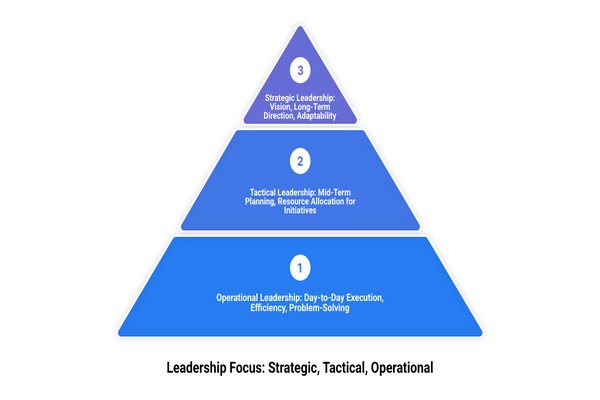
Strategic business leadership, however, lifts beyond these. It’s about setting the overarching direction, envisioning the future state of the organization, and making decisions with long-term implications. Strategic leaders don’t just solve problems; they anticipate them. They don’t just manage resources; they align them to future opportunities. This requires a profound understanding of the organization’s mission, values, and its place in the broader ecosystem.
Here’s a comparison to illustrate these differences:
Feature Operational Leadership Tactical Leadership Strategic Leadership Focus Day-to-day tasks, efficiency, current processes Specific projects, short-to-medium term initiatives Long-term vision, organizational direction, future Timeframe Daily, weekly Weeks, months, quarters Years, decades Scope Departmental, team-specific Cross-departmental, project-specific Entire organization, industry, global environment Key Questions How do we do this efficiently? What needs fixing now? How do we achieve this specific goal? What’s the plan? Where are we going? Why are we doing this? What’s next? The Strategic Mindset: Seeing the Bigger Picture
A strategic leader possesses a unique mindset that allows them to see the forest and the trees. They are constantly scanning the horizon, analyzing market trends, competitive landscapes, technological advancements, and socio-economic shifts. This foresight allows them to anticipate disruption and proactively shape the future, rather than merely reacting to it.
Moving beyond day-to-day management means delegating operational and tactical responsibilities effectively, trusting teams to handle the immediate while the leader focuses on the distant. This doesn’t mean detachment; it means empowering others to excel in their domains, freeing up the strategic leader to engage in critical thinking, scenario planning, and visionary communication. The ability to empower and guide teams through complex operational challenges is a hallmark of effective strategic operational leadership. This capability ensures that while the organization pursues its long-term vision, its daily functions remain robust and aligned.
The Anatomy of a Strategic Leader: Core Skills and Mindset
What exactly makes a leader “strategic”? It’s a combination of inherent qualities and cultivated skills that enable them to steer complexity, inspire action, and drive an organization toward its envisioned future. While many leadership traits are valuable, strategic leaders possess a distinct set that allows them to excel in dynamic environments.

Research involving over 20,000 executives has identified six essential skills that define effective strategic business leadership, especially in contexts of high stakes and deep uncertainty:
- Anticipate: Strategic leaders don’t just react; they proactively scan the environment for potential changes, opportunities, and threats. They ask “What if?” and “What’s next?”
- Challenge: They question the status quo, conventional wisdom, and their own assumptions. They encourage diverse viewpoints and constructive dissent to uncover new possibilities.
- Interpret: Strategic leaders can make sense of ambiguous data and conflicting signals. They connect disparate pieces of information to form a coherent understanding of complex situations.
- Decide: They are capable of making tough decisions with long-term implications, even with incomplete information, balancing thorough analysis with decisive action.
- Align: They communicate their vision and strategy compellingly, building consensus and commitment across the organization, ensuring everyone is moving in the same direction.
- Learn: Strategic leaders are committed to continuous learning, both from successes and failures. They reflect on outcomes, adapt their approaches, and foster a culture of organizational learning.
These six skills work in concert, forming a powerful framework for strategic thinking and action.
Visionary and Adaptive Thinking
At the heart of strategic leadership lies visionary thinking – the ability to articulate a clear, compelling picture of the future and inspire others to pursue it. This vision isn’t static; it’s coupled with profound adaptability. Strategic leaders understand that the path to the future is rarely linear. They possess the flexibility to pivot strategies when circumstances change, the open-mindedness to accept new ideas, and the courage to encourage diverse viewpoints, knowing that complex problems often require novel thinking. They are resolute in their goals but flexible in their methods, constantly responding to environmental shifts.
Decisiveness and Emotional Intelligence
Strategic decisions often involve significant risk and uncertainty. Therefore, a strategic leader must be decisive, capable of making informed choices based on data, analysis, and intuitive judgment. This decisiveness is tempered by a high degree of emotional intelligence, which is crucial for effective leadership.
Emotional intelligence involves understanding and managing one’s own emotions, as well as recognizing and influencing the emotions of others. Strategic leaders with high EQ can:
- Communicate effectively: They articulate their vision and strategies clearly, persuasively, and empathetically, building trust and inspiring action.
- Build strong relationships: They foster collaboration, manage conflict, and create an inclusive environment where individuals feel valued and heard.
- Steer complexity and uncertainty: Their self-awareness helps them stay calm under pressure, and their empathy allows them to understand and address the concerns of their teams during periods of change.
By combining analytical rigor with emotional insight, strategic leaders can make robust decisions that are not only sound but also resonate with and motivate their teams, driving organizational change and achieving long-term goals even in the face of significant complexity and uncertainty.
Why Strategic Leadership is the Engine of Sustainable Success
In today’s , interconnected, and often unpredictable business environment, strategic business leadership is not merely an advantage-it is an absolute necessity for organizational survival and sustained success. Without it, companies risk becoming irrelevant, outmaneuvered by competitors, or unable to withstand unforeseen challenges.
Driving Innovation and Gaining a Competitive Edge

Strategic leaders understand that innovation is not an optional extra but a continuous imperative. They actively foster a culture where creativity and experimentation are encouraged, and even failure is seen as a valuable learning opportunity. By creating “safe-to-fail” environments, they empower teams to explore new ideas without fear of severe repercussions, leading to breakthroughs. Companies like Google, for instance, have historically leveraged multiple channels to promote innovation, including direct access to leaders and “Google cafés” designed to spark cross-team interaction.
This relentless pursuit of innovation allows organizations to differentiate themselves from competitors, develop unique products or services, and continuously adapt their business models. A strategic leader’s focus on anticipating future trends and interpreting market signals ensures that these innovations are not random but strategically aligned to secure and sustain a competitive advantage. This impact extends beyond market share, influencing brand reputation and long-term viability.
Building Organizational Resilience in a Dynamic World
The modern business landscape is characterized by constant change, from technological disruptions to global economic shifts. Strategic business leadership is crucial for building organizational resilience – the capacity to anticipate, prepare for, respond to, and adapt to incremental change and sudden disruptions in order to survive and prosper.
Strategic leaders achieve this by:
- Proactive Contingency Planning: They don’t just have Plan A; they have Plans B, C, and D, anticipating various scenarios and preparing responses.
- Fostering Agility: They build flexible structures and processes that allow the organization to pivot quickly when necessary, rather than being rigid and slow to react.
- Promoting Continuous Learning: They ensure that the organization learns from every experience, good or bad, embedding lessons into future strategies and operations.
- Managing Change Effectively: They understand that change often brings resistance and proactively address concerns, communicate transparently, and build consensus to overcome obstacles. This often involves preparing for what are sometimes called “wicked problems”-complex, interconnected challenges that defy simple solutions.
By cultivating these attributes, strategic leaders ensure their organizations are not just surviving, but thriving amidst uncertainty, enhancing overall performance, and building stakeholder satisfaction through consistent, forward-thinking guidance.
Cultivating a Culture of Strategic Business Leadership
The presence of strategic leaders at the top is vital, but for an organization to truly flourish, strategic thinking must permeate all levels. Cultivating a culture of strategic business leadership means empowering employees to think beyond their immediate roles, contribute to the larger vision, and develop their own strategic capabilities.
How Organizations Can Foster Strategic Talent
Organizations play a critical role in nurturing strategic talent. This isn’t just about sending a few executives to a seminar; it’s about embedding strategic development into the very fabric of the company. Key practices include:
- Distributing Responsibility: Empowering employees at all levels to make decisions and take ownership of initiatives. This pushes power downward, allowing diverse perspectives to inform strategic choices.
- Information Transparency: Sharing a broad base of data and strategic insights beyond a strict “need-to-know” basis. When employees understand the bigger picture, they can make more strategically aligned decisions.
- Cross-functional “Practice Fields”: Creating opportunities for potential strategic leaders to work on complex, real-world problems in a simulated or cross-departmental setting. This experiential learning allows them to develop strategic acumen without the full risk of live operations.
- Providing Access to Other Strategists: Facilitating mentorship, peer-to-peer learning, and networking opportunities with experienced strategic thinkers, both inside and outside the organization.
- Making It Safe to Fail: Establishing a culture where experimentation and learning from mistakes are valued. When failure is seen as a stepping stone to innovation, employees are more likely to take calculated risks essential for strategic growth.
- Recognizing Development as an Ongoing Practice: Leadership development is a continuous journey. Organizations should provide resources and support for lifelong learning, including opportunities for reflection and skill refinement.
How to Cultivate Your Own Strategic Business Leadership Qualities
For individuals aspiring to become strategic leaders, personal development is paramount. It requires intentional effort and a commitment to continuous growth:
- Find Time to Reflect: Strategic leaders are skilled in “double-loop learning,” which involves not just understanding a situation but also studying one’s own thinking, biases, and assumptions about it. Regularly stepping back to reflect on decisions, outcomes, and personal reactions can uncover deeper insights.
- Question Assumptions: Challenge your own ingrained beliefs and the prevailing wisdom. Actively seek out information that contradicts your views to develop a more nuanced understanding of complex issues.
- Seek Diverse Experiences: Step outside your comfort zone. Take on cross-functional projects, work in different departments, or even volunteer for roles that expose you to new challenges and perspectives.
- Develop a Personal Leadership Credo: Articulate your core values, principles, and what you stand for as a leader. This clarity provides a compass for decision-making and helps you lead with authenticity.
- Continuous Learning: Engage in ongoing education through books, articles, podcasts, and professional development programs. The landscape is constantly changing, and strategic leaders must evolve with it.
By embracing these practices, individuals can systematically cultivate the strategic mindset and skills necessary to lead effectively, contributing significantly to their organizations and their own career development.
From Vision to Value: Applying Strategy in Growth, Operations, and Exits
Strategic business leadership isn’t just about abstract vision; it’s about translating that vision into tangible value across all facets of the business lifecycle. This involves connecting strategy to execution, aligning resources, creating unity of action, driving organizational change, and ultimately achieving long-term goals, whether those goals are rapid expansion or a successful transition.
Leadership for Growth and Scalability
For companies focused on growth, strategic leadership is the foundational element. It ensures that expansion is not haphazard but deliberate and sustainable. Strategic leaders:
- Align Teams with a Clear Vision: They ensure every team member understands the growth objectives and how their individual contributions fit into the larger picture. This clarity prevents fragmentation and ensures concerted effort.
- Empower Decision-Making Across the Organization: As organizations scale, centralized decision-making becomes a bottleneck. Strategic leaders empower managers at various levels to make strategic decisions relevant to their domains, fostering agility and responsiveness. This shifts the focus from individual problem-solving to collective strategic action.
- Guide Market Entry and Expansion: Whether it’s entering new geographic markets or launching new product lines, strategic leaders conduct thorough analyses, anticipate challenges, and position the company for success, ensuring scalability without losing strategic focus.
Leadership for a Strategic Exit
Perhaps one of the most critical applications of strategic business leadership, especially for founders and owners, is in planning for a strategic exit. This isn’t an afterthought but a process that should begin well before an offer materializes. The goal is to maximize value, ensure a smooth transition, and align the exit with the founder’s personal and financial objectives.
It’s a common misconception that an Initial Public Offering (IPO) is the primary exit route for successful companies. In reality, over 97% of actual exits occur through mergers and acquisitions (M&A). This makes understanding the M&A landscape a crucial aspect of strategic planning for any business owner.
Effective strategic leadership in this context involves:
- Exit Strategy Planning: Defining what a successful exit looks like, considering factors like valuation, timing, buyer type (strategic vs. financial), and post-acquisition roles.
- Maximizing Value: Implementing strategies throughout the company’s lifecycle that improve its attractiveness to potential buyers, such as building robust intellectual property, diversified revenue streams, and a strong management team.
- Navigating M&A Complexities: The M&A process is intricate, involving due diligence, negotiations, legal frameworks, and integration challenges. Expert guidance from specialists in strategic tech M&A leadership can be invaluable in navigating these waters, ensuring the best possible outcome for all stakeholders.
For founders, the question of what happens after the sale is paramount. Strategic leaders consider their options carefully:
Post-Acquisition Role Options for Founders:
- Complete Exit: Stepping away from the company entirely after a transition period.
- Leading New Initiatives: Remaining within the acquiring company to head new projects or divisions, leveraging expertise on a larger platform.
- Continuing in Current Role: Especially common with private equity acquisitions, where founders might roll equity and continue to lead the business with new capital and resources.
- Board of Directors Position: Taking a strategic advisory role, staying involved at a high level without day-to-day operational responsibilities.
Throughout this process, understanding and mitigating potential liabilities is key. The role of strategic business risk leadership becomes critical in identifying and addressing potential challenges that could impact the deal, such as regulatory problems, operational risks, or market shifts. By proactively managing these risks, strategic leaders ensure a more secure and profitable transaction.
Frequently Asked Questions about Strategic Business Leadership
What is the biggest difference between a strategic leader and an operational manager?
A strategic leader focuses on the long-term direction, vision, and adaptability of the entire organization (“where are we going and why?”), while an operational manager focuses on the efficient execution of current tasks and processes to achieve immediate goals (“how do we get today’s work done best?”). While both are essential, the strategic leader’s scope is broader, looking years ahead and across the entire ecosystem, whereas the operational manager’s focus is on optimizing current performance within established parameters.
How can a company identify potential strategic leaders within its ranks?
Look for individuals who consistently think beyond their immediate role, ask challenging questions about the “why” behind decisions, connect disparate ideas, demonstrate a high degree of adaptability, and can influence others toward a common goal, even without formal authority. They often show curiosity about market trends, competitive shifts, and the broader implications of their work. Providing cross-functional projects and opportunities for reflection can also reveal these latent strategic capabilities.
Is strategic leadership only for C-suite executives?
No. While the C-suite is ultimately responsible for the overall strategy, a truly effective organization fosters a culture of strategic leadership at all levels. This empowers individuals throughout the company to think strategically about their work, contribute innovative ideas, understand how their role contributes to the company’s long-term success, and take initiative to solve problems with a future-oriented mindset. Distributed strategic thinking improves organizational agility and resilience.
Conclusion
Strategic business leadership is the compass that guides organizations through the complexities of the modern world. It’s about having a clear vision, the agility to adapt, and the emotional intelligence to inspire and align teams. From driving innovation and building resilience to navigating periods of intense growth and preparing for critical strategic exits, this leadership approach is indispensable.
Cultivating strategic leadership is a continuous journey, not a destination. It requires both organizational commitment to fostering talent and individual dedication to personal growth and reflection. By embracing the principles and developing the skills of strategic business leadership, we can fortify our businesses against uncertainty, open up their full potential, and ensure sustainable success for years to come.